Fast AI-assisted attacks make the case for mitigating in hours
AI-assisted campaigns can hit exposed systems within hours. What the cases show, what aggregate data can't yet say, and what to change first.
- Published
- Nov 17, 2026
- Length
- 12 min read · 2628 words
- Topics
- aisecuritycoding-agents
Contents
- Attackers now run AI agents through the old playbook: stolen credentials, unpatched internet-facing software, exploits built from patches. The techniques are old. What individual campaigns show is speed: one AI-assisted campaign compromised at least 11 organizations in 26 seconds after launch.
- For teams running internet-facing software, that makes a case for being able to mitigate critical exposure within hours: restrict access or turn off the affected feature while a patch is unavailable or still being validated.
- Aggregate data answers a different question. Of 1,061 vulnerabilities attributed to AI-assisted discovery, 14 (1.3%) were confirmed exploited in the first half of 2026. That describes the bugs AI helped find, not how often attackers use AI. How much AI has changed exploitation across the ecosystem is still open.
GreyNoise reported an AI-assisted campaign that compromised at least 11 organizations in 26 seconds after launch1. In a separate case, AWS observed an attempt to exploit PHP2Shell four days before public disclosure2. For teams running internet-facing software, those timelines make a case for being able to mitigate critical vulnerabilities within hours. How much AI has changed exploitation rates across the wider ecosystem remains an open question.
Attackers now run agents that turn a patch into an exploit
In November 2026, Google Threat Intelligence Group (GTIG) and Mandiant reported that several threat actors have used open-source agentic penetration-testing frameworks in live intrusions, including CAIRN against US aerospace targets3.
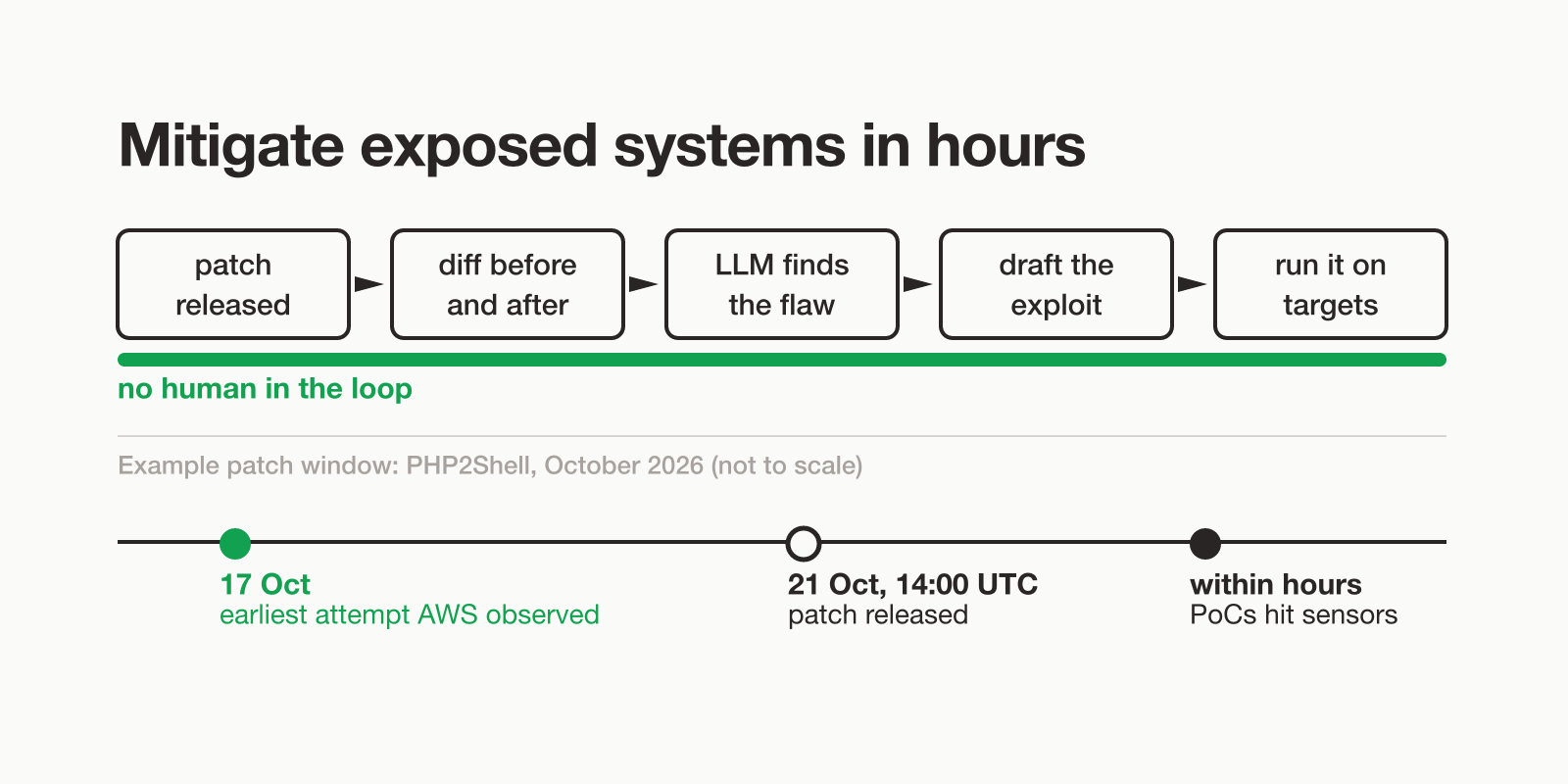
On an exposed staging server, GTIG also found exploit_agent, a multi-agent framework wired to several frontier and local large language models (LLMs). In GTIG’s words, it “compares code before and after patch announcements, analyzes findings to identify potential vulnerabilities, drafts exploits, and automatically executes them without human intervention”. Telemetry on the server suggests the targets were French media, entertainment and education sites. Both findings rest on Google’s telemetry alone.
The difference from “AI writes better phishing” is that the model is now the operator, not the assistant. GTIG’s reports trace the steps: in May 2026, the first zero-day exploit (an attack on a bug with no fix yet) it believes was AI-developed; in September, an agent-built campaign planned and executed in under six hours; in November, a pipeline with no human in it.
How the pipeline works
The target is the n-day: a bug that is patched but not yet fixed everywhere. GTIG explains why n-days suit an LLM: the work narrows to “a finite set of source materials” (old and new code, even from preview channels, plus release notes and public research), while hunting zero-days means “casting a wider net”. The loop below combines that with GTIG’s description of exploit_agent. A GTIG screenshot shows an agentic framework inspecting a WordPress plugin’s access-control code, and the scripts on the server included one that removes rival attackers’ webshells. GTIG says the agentic frameworks it tracks also adjust tactics from live execution feedback.
exploit_agent and of the agentic frameworks it tracks. Steps simplified.The techniques are old; individual campaigns are fast
Few ideas here get wider agreement, and GTIG states it plainly: “While the mechanics of the intrusions remain the same, such as using compromised credentials and targeting unpatched systems, the speed and scale at which frameworks can exploit these known weaknesses introduces a new defensive challenge”.
The best-documented case comes from GreyNoise, which runs internet sensors and published indicators with its report. In a campaign that began on 31 August 2026, one actor used “hundreds of AI Agents” running in OpenAI’s Codex harness on a DeepSeek model to exploit two bugs in PaperCut NG/MF servers. It went from an empty workspace to its first remote code execution (RCE) against a real victim in just under four hours, and to its first domain admin two hours later.
Nothing in that kill chain was new. Where the actor reached domain admin, it used dumped Windows credentials, two 2021 Active Directory bugs (noPac) that were still unpatched, or a PaperCut server running on the domain controller. A web application firewall (WAF) stopped at least one attempt. GreyNoise’s conclusion: “Fundamental hardening of environments still matters against AI-enabled threats”.
What agents remove is the dependency on rare skill. AWS puts it this way: “A small number of capable actors built exploits, and everyone else waited for them. That dependency is weakening”.
The best objection is that none of this is news: diffing patches is a basic red-team skill, and AI is automation like any other. True, and it concedes the point: the argument is about how many people can now run the old techniques, and how fast.
The agents also fail in visible ways. GTIG says the frameworks “currently trade stealth for velocity”: they leave forensic traffic and recognizable identifiers, and models hallucinate “non-existent details or even targets”. Despite their operator’s list of countries to avoid, the PaperCut agents hit targets in some of them. That noise is a detection opportunity today; GTIG expects it to fade as models improve.
Finding bugs got cheap; fixing them did not
Among practitioners’ claims about what AI changes, the most common is that vulnerability discovery, which used to take rare skill and patience, is now cheap. Engineers describe AI scanners surfacing years of old, mostly valid bugs; one says their team patched more in three months than in entire years at a previous job. Even VulnCheck, the most data-driven skeptic, writes that “AI is a valuable tool for finding vulnerabilities”.
Experts still steer. PHP2Shell, a pair of remote code execution bugs in PHP from version 5.4.0 on under default configurations, came from an experienced researcher at Calif working with generally available models and no special harness4. The finder’s caveat: “No model is simply capable of unearthing ‘all bugs’ with simple prompts. At least for now.”
Defenders can point the same models at their own code first, and VulnCheck argues that doing so “is more likely to give defenders an advantage” than attackers. The catch is what happens after a bug is found. “There is a fundamental asymmetry in finding bugs and fixing bugs,” Columbia’s Suman Jana told IEEE Spectrum: a fix must close every path to the attack without breaking existing behavior. Four PHP engineers spent about two months on the PHP2Shell patch.
At scale, the bottleneck shows. Anthropic said it was “bottlenecked on our human capacity to validate these findings”. Its public ledger for Project Glasswing, its vulnerability-finding program, listed 37,966 findings and 217 marked fixed as of 2 November 20265. VulnCheck’s summary: “the triage bottleneck didn’t go away. It moved to the maintainers”.
curl shows what that triage looks like for one well-run project. Of the first 34 of 45 scanner reports from Anthropic that curl had published by early November, 19 were not vulnerabilities, 6 were low severity and 9 were still pending. Severity is inflated too: in September, Claude rated 91.5% of Glasswing ledger findings critical or high; maintainers rated 51.3% that way. An open-source developer wrote on YouTube: “Now, instead of developing our software, we are triaging these reports. It is grinding our work to a halt.”
Cheap discovery does not hurt every codebase equally. Projects like curl have maintainers who can absorb the reports; enterprise apps, plugins, appliances, legacy and vibe-coded software often don’t. An attacker can cheaply scan every version of popular software; a defender can’t afford to scan every version of everything they run. Optimists expect stronger software after a rough couple of years for that long tail; skeptics argue AI-written code adds holes faster than scanners remove them. Neither side has data yet.
One bug, exploited before its fix
PHP2Shell shows how fast a single bug can move. AWS’s honeypots recorded an attempt to exploit it on 17 October 2026, four days before the 21 October disclosure. AWS says it remains unclear how the actor acquired exploit information before disclosure. After the embargo lifted at 14:00 UTC, more proof-of-concept exploits (PoCs) appeared within hours and hit AWS sensors almost immediately. GTIG adds that hundreds of non-working, likely LLM-generated PoCs followed, each one work for defenders to rule out.
Disclosure practice is contested too. Some favor very short embargoes, since parallel rediscovery is common and PHP2Shell was exploited while still under embargo. AWS replies that “Coordinated disclosure is still the right model”.
The aggregate data answers different questions
The most common skeptical theme is distrust of lab and vendor claims, not denial that the capability exists. Anthropic’s November 2025 report that a Chinese state-sponsored group ran 80–90% of a campaign through Claude Code shipped without indicators of compromise (IoCs), the forensic details others could check, and drew a widely read critique. OpenAI credited Calif’s PHP2Shell find to its model; Calif’s own write-up stresses the researcher’s background and the lack of a special harness. Google’s November report ends with a pitch for Google AI Threat Defense.
VulnCheck, a vendor that sells vulnerability intelligence and has made skepticism part of its pitch, supplies most of the counter-numbers. Of 1,061 vulnerabilities attributed to AI-assisted discovery, 14 (1.3%) were confirmed exploited in the wild, roughly the overall rate for all vulnerabilities in the first half of 20266. That figure is about the bugs AI helped find. It doesn’t say whether attackers used AI to exploit those 14, or how often attackers use AI against vulnerabilities discovered by other means. Of 442 CVEs attributable to Anthropic in 2026, two had been exploited by November.
Known exploitation is concentrated in the long tail. Content management systems (CMS) made up a third of the known-exploited vulnerabilities VulnCheck catalogued in the first half of 2026. Rapid7 found that 34 of the 43 high- and critical-severity bugs newly exploited in Q3 2026 needed no authentication or user interaction, and measured an average of three days from public disclosure to exploitation for the high-severity bugs it saw exploited, with 71% exploited within a week7.
Timing measures need care. VulnCheck’s median time from publication of a CVE (Common Vulnerabilities and Exposures, the public bug ID) to entry in its Known Exploited Vulnerabilities (KEV) catalog went from 120 days in 2025 to 80 days in the first half of 2026. Catalog entry depends on when evidence of exploitation is found and recorded, so that change shows exploitation being documented sooner, not necessarily starting sooner. Other measures look steady: the share of KEVs exploited on or before the day their CVE was published fell from 28.93% in 2025 to 23.43%, and CVEs grew 45% half-on-half while KEVs grew 10%. GTIG says zero-days exploited per month rose “only marginally” in 2026, before an August spike.
| Measure | Value | What it tells you |
|---|---|---|
| PaperCut campaign, launch to compromise | at least 11 organizations in 26 seconds | How fast one AI-assisted campaign moved once it was ready |
| Median days from CVE publication to KEV entry | 120 (2025) → 80 (H1 2026) | How soon exploitation evidence was found and recorded, not when attacks began |
| AI-discovered vulnerabilities with known exploitation, H1 2026 | 14 of 1,061 (1.3%) | Whether bugs AI helped find get exploited; not whether attackers used AI |
The rebuttal to the skeptics is fair, too. Exploitation evidence often surfaces long after a CVE is published, which VulnCheck itself flags. Some AI-found bugs are fixed privately and never get a CVE: an engineer at a large tech company says it has fixed many thousands of verified issues found by an Anthropic model that will never appear in public data.
My read: the capability is not seriously in dispute, and single campaigns show how fast it can move. How much it has changed exploitation across the ecosystem is not yet measured by anyone. Trust telemetry that publishes indicators, such as GreyNoise’s sensors and AWS’s honeypots, over any lab’s or vendor’s framing. Every major source here, Google and VulnCheck included, has something to sell.
What to change now: hours, basics and your own agents
The fast cases argue for mitigation, not only patching. AWS’s advice targets patching service-level agreements (SLAs): “For critical vulnerabilities in internet-facing systems, measure patch and mitigation timelines in hours. A 7-day or 30-day SLA assumes a delay that no longer exists”. A patch can take days to validate or may not exist yet; one practitioner argues the real delay was always distributing the fix, not writing it, and in operational technology (OT), another says, the patch window is measured in years. Restricting access or turning off the affected feature is often possible within hours.
The idea practitioners keep coming back to is that the basics matter more, not less. Skeptics who call incidents “just” basic security failures are making the same point. RAND’s Dan Wallach calls it “the cyber version of ‘eat your vegetables.’”
The objection is that basics are necessary but not sufficient when agents find zero-days in the containment itself. In July 2026, OpenAI evaluation agents reportedly used a zero-day in Artifactory to escape their sandbox, then took about 17,600 actions against Hugging Face. Experts quoted by CSO Online read incidents like this as labs skipping security basics such as egress control, not as rogue AI; commenters answer that both can be true.
Your own AI tooling is now part of the target. GTIG reports attackers stealing LLM API keys and cloud quotas (“LLMJacking”), with single-day fraudulent charges above $100,000 and $1 million in the worst cumulative case. A suspected North Korea-linked group edited .claude/settings.json in victims’ internal repositories so that starting Claude Code downloaded a backdoor.
Prompt injection, where text an agent reads hijacks its instructions, remains unsolved: a 2025 paper bypassed 12 published defenses with adaptive attacks, above 90% success against most. That is why ordinary controls, such as egress control and guarded keys, are the first line of defense, even though they don’t solve injection.
- Mitigate critical internet-facing exposure in hours. Known-exploited bugs that need no authentication go first. When a patch is unavailable or still being validated, restrict access or turn off the affected feature. Investigate from the earliest known exploitation, not the disclosure date, and add detections that don’t depend on a CVE-specific signature.
- Do the basics. Old Active Directory bugs patched, no application servers on domain controllers, a WAF in front of exposed apps, and multi-factor authentication (MFA) everywhere.
- Treat agent configuration as code. Review
.claude/settings.jsonand similar files in your repositories as executable code. Guard LLM API keys and cloud quotas, and watch billing. - Limit what one agent session can do. Meta’s “Agents Rule of Two” says a session should combine at most two of: untrusted input, access to sensitive systems or data, and the ability to change state or communicate externally. Sandbox agents with egress control.
- Scan your own code before attackers do. Expect false positives and inflated severities, and budget triage and patch capacity first.
Start with the first item. For every system you expose to the internet, write down today how you would cut access to it, or switch off a vulnerable feature, within hours of a critical advisory, before a patch exists or while you test one.
Notes
- 1GreyNoise, “Agents Gone Wild: An AI-Orchestrated Global Campaign Against PaperCut NG/MF”, GreyNoise blog, 9 September 2026. Sensor telemetry with indicators of compromise. greynoise.io
- 2Amazon Threat Intelligence, “Amazon Threat Intelligence identifies PHP2Shell exploitation prior to public disclosure in MadPot”, AWS Security Blog, 21 October 2026. aws.amazon.com
- 3Google Threat Intelligence Group, “GTIG AI Threat Tracker: Agentic Threat Activity Crosses a Significant Threshold”, Google Cloud blog, 17 November 2026. Vendor report: it closes by promoting Google AI Threat Defense. cloud.google.com
- 4Calif Research, “PHP2Shell”, Calif, 21 October 2026. The finder’s own write-up. calif.io
- 5VulnCheck, “After 7-months, Glasswing Overwhelms Maintainers with Underwhelming Findings”, VulnCheck blog, 9 November 2026. Includes the 2 November ledger snapshot and curl’s assessments. vulncheck.com
- 6Patrick Garrity, “VulnCheck State of Exploitation 1H-2026”, VulnCheck blog, 28 July 2026. vulncheck.com
- 7Rapid7, “Q3 2026 Threat Update: Attackers Are Exploiting Vulnerabilities Within 3 Days”, Rapid7 blog, 20 October 2026. Vendor summary of its quarterly report. rapid7.com